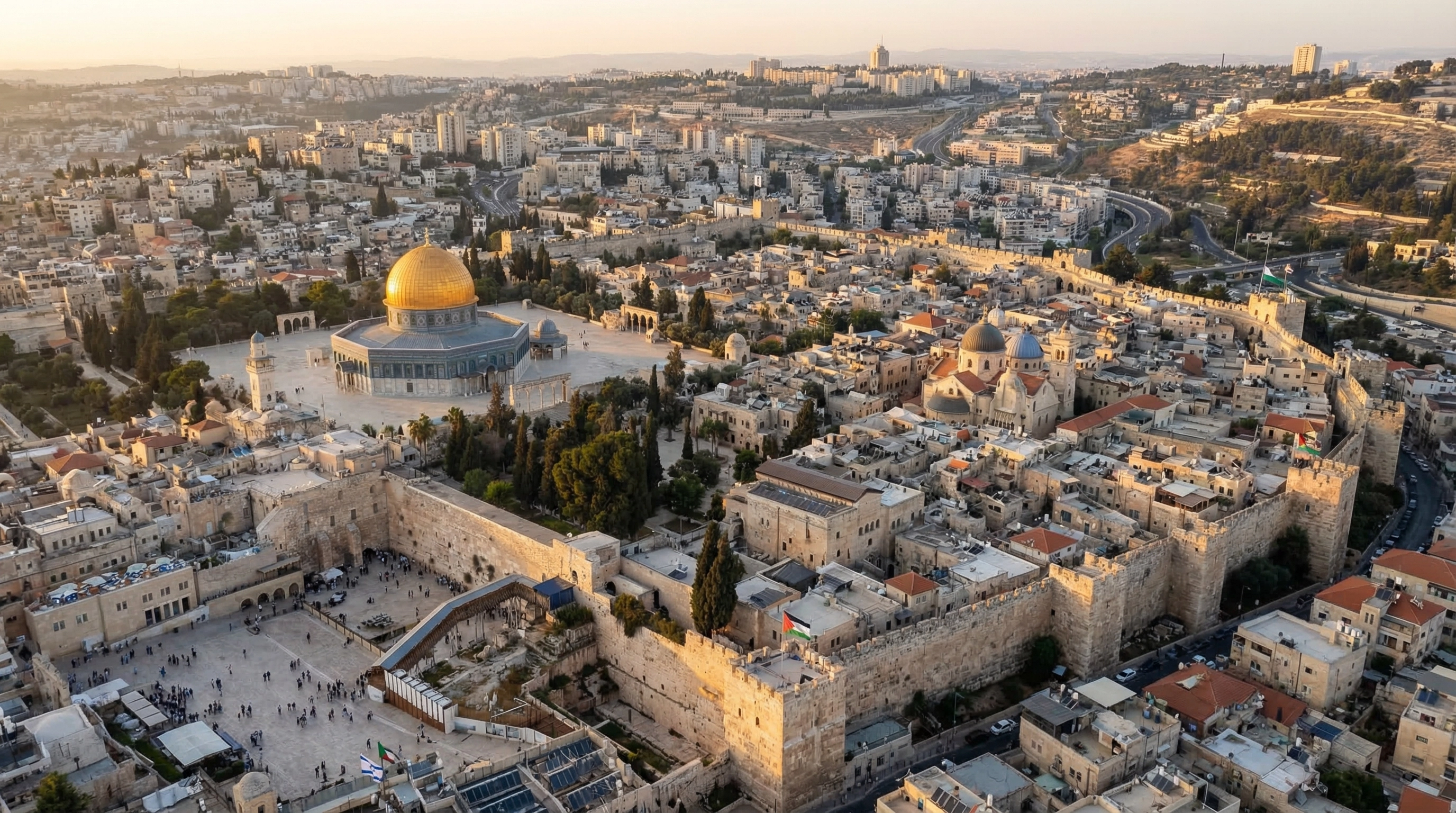
Israel / Palestine
The Israeli-Palestinian conflict is the most documented and most analysed conflict in this database, and also the most politically contested in terms of how it is framed. The conflict has been frozen in its current form since the collapse of the Oslo peace process and the Second Intifada in 2002. The Gaza Strip has been under Hamas control since 2007. The West Bank remains under Israeli military occupation with expanding settlements. The October 2023 Hamas attack and subsequent Israeli military campaign in Gaza have fundamentally altered the conflict's trajectory and produced a humanitarian catastrophe.
Key Fact
Palestine is recognised as a state by 146 UN member states. The two-state solution has been the stated goal of international diplomacy for 30 years but has not been achieved. Israeli settlement construction in the West Bank has made a contiguous Palestinian state increasingly difficult to implement. The October 2023 Hamas attack killed ~1,200 Israelis; the subsequent Israeli military campaign in Gaza has killed over 40,000 Palestinians (as of early 2025) and displaced virtually the entire population of Gaza.
Historical Timeline
| Period | Ruling Authority | Notes |
|---|---|---|
| 1917–1948 | British Mandate | Balfour Declaration (1917): British support for a Jewish homeland in Palestine; Arab population opposes Jewish immigration; 1936–39 Arab Revolt; Holocaust accelerates Jewish immigration; 1947 UN Partition Plan (Resolution 181); Arab states reject partition |
| 1948–1949 | Israeli War of Independence / Nakba | Israel declares independence May 1948; Arab states invade; Israel wins; ~700,000 Palestinians flee or are expelled (Nakba); armistice agreements 1949; Gaza under Egyptian administration; West Bank under Jordanian administration |
| 1967 | Six-Day War | Israel captures West Bank, Gaza, Sinai, and Golan Heights in six days; UN Security Council Resolution 242 calls for Israeli withdrawal from occupied territories; Israeli settlement construction begins |
| 1973–1993 | Occupation and First Intifada | Yom Kippur War 1973; Camp David Accords 1978 (Egypt-Israel peace); First Intifada 1987–93; PLO recognises Israel 1988; Oslo Accords 1993: mutual recognition; Palestinian Authority established |
| 1993–2000 | Oslo process | Oslo I (1993) and Oslo II (1995); Palestinian Authority established in parts of West Bank and Gaza; Israeli settlement construction continues; Camp David Summit 2000 fails; Second Intifada begins September 2000 |
| 2000–2007 | Second Intifada and disengagement | ~3,000 Palestinians and ~1,000 Israelis killed; Israeli security barrier construction; Israeli disengagement from Gaza 2005; Hamas wins Palestinian legislative elections 2006; Hamas takes control of Gaza 2007 |
| 2007–2023 | Gaza blockade and periodic wars | Israeli-Egyptian blockade of Gaza; Operation Cast Lead (2008–09); Operation Pillar of Defense (2012); Operation Protective Edge (2014); Great March of Return (2018–19); Operation Guardian of the Walls (2021); West Bank settlement expansion accelerates |
| October 2023–present | October 7 and Gaza War | Hamas attack on Israel October 7, 2023: ~1,200 killed, ~250 taken hostage; Israeli military campaign in Gaza; over 40,000 Palestinians killed; virtually entire Gaza population displaced; International Court of Justice proceedings; ICC arrest warrants for Israeli and Hamas leaders |
Foreign Policy Analysis
Three-level analysis: systemic, state, and individual factors
Systemic Level
The Israeli-Palestinian conflict is the most externally influenced frozen conflict in this database. The US provides ~$3.8 billion annually in military aid to Israel and has historically vetoed UN Security Council resolutions critical of Israeli settlement construction. Arab states have historically used the Palestinian cause as a political instrument while providing limited practical support to Palestinians. Iran funds Hamas and Palestinian Islamic Jihad. The Abraham Accords (2020) normalised relations between Israel and the UAE, Bahrain, Sudan, and Morocco without resolving the Palestinian question. Saudi-Israeli normalisation negotiations, which were ongoing before October 2023, have been suspended. The October 2023 war has produced the most significant shift in international opinion on the conflict since 1967: European governments that previously supported Israel unconditionally have moved toward calling for a ceasefire and recognising Palestinian statehood.
State Level
Israel's official position is that it supports a two-state solution but that Palestinian statehood requires security guarantees and the renunciation of violence. The current Netanyahu government includes ministers who explicitly oppose Palestinian statehood. The Palestinian Authority's position is that it supports a two-state solution based on 1967 borders with East Jerusalem as the capital. Hamas's position is that it does not recognise Israel's right to exist and that armed resistance is legitimate. Note: This conflict has the most politically polarised source landscape of any conflict in this database. Israeli government sources, Palestinian Authority sources, Hamas sources, US government sources, Arab government sources, and international human rights organisations all present fundamentally different accounts of the same events. This knowledge base presents the factual record and notes where accounts diverge, without endorsing any party's framing.
Individual Level
Benjamin Netanyahu's political survival has depended on maintaining a right-wing coalition that includes ministers opposed to Palestinian statehood. His personal legal situation (facing corruption charges) creates incentives to remain in power that may influence his decision-making. Yahya Sinwar (Hamas leader, killed October 2024) was the architect of the October 7 attack. Mahmoud Abbas (Palestinian Authority president) has been in office since 2005 without an election; his legitimacy is contested by Hamas and by a significant portion of the Palestinian population.
Policy Paths
Three documented approaches to resolution — with their consequences
Two-State Solution
An independent Palestinian state alongside Israel, based on 1967 borders with land swaps, with East Jerusalem as the Palestinian capital and a negotiated resolution of the refugee question.
Consequences
The stated goal of international diplomacy for 30 years. Israeli settlement construction in the West Bank has made a contiguous Palestinian state increasingly difficult to implement. The current Israeli government includes ministers who explicitly oppose it. The October 2023 war has made near-term negotiations impossible. 146 UN member states recognise Palestine as a state; recognition has accelerated since October 2023.
Examples
Oslo Accords (1993): the framework for a two-state solution; collapsed at Camp David 2000. The two-state solution has been the international consensus for 30 years without being achieved.
One-State Solution (Democratic)
A single democratic state between the Jordan River and the Mediterranean Sea, with equal rights for all citizens regardless of ethnicity or religion.
Consequences
Supported by some Palestinian intellectuals and left-wing Israeli voices. Rejected by the Israeli government, which argues it would end Israel as a Jewish state. Rejected by the Palestinian Authority, which seeks an independent state. Demographic projections suggest that Palestinians would constitute a majority in a single state.
Examples
South Africa (1994): transition from apartheid to a democratic state with equal rights. The analogy is contested: Israeli governments reject the apartheid comparison.
Continued Occupation / Status Quo
Israel maintains military control of the West Bank and a blockade of Gaza, without a negotiated resolution.
Consequences
The current de facto policy. Settlement construction continues, making a two-state solution increasingly difficult. International isolation of Israel is increasing. The October 2023 war has accelerated recognition of Palestinian statehood by European governments.
Examples
The current situation: stable from Israel's security perspective but producing chronic humanitarian crisis in Gaza and the West Bank.
Escalation / Regional War
The October 2023 war expands to a regional conflict involving Hezbollah, Iran, and potentially other actors.
Consequences
The Israeli-Hezbollah war of 2024 was a significant escalation. Iranian-Israeli direct military exchanges have occurred. A full regional war would involve multiple state and non-state actors and could draw in the US.
Examples
The 1973 Yom Kippur War: a regional conflict that drew in the superpowers and produced an oil embargo. The current situation has structural parallels.
Conditional Equilibrium
The Israeli-Palestinian conflict has never achieved a stable frozen status: it has been characterised by periodic escalation rather than genuine freezing. The Oslo process created a conditional equilibrium that collapsed at Camp David in 2000. The current situation is not a frozen conflict in the traditional sense: it is an active occupation with periodic armed escalation. The October 2023 war has fundamentally altered the conflict's trajectory: the two-state solution is further from implementation than at any point since 1967, while international recognition of Palestinian statehood is accelerating.
Escalation Risk
Probability assessment and specific trigger conditions for conflict escalation
The Israeli-Palestinian conflict carries the highest escalation risk of any conflict in this database. The October 2023 war is ongoing, a regional war involving Iran and Hezbollah has partially occurred, and the conditions for a broader regional conflict remain present. The two-state solution is further from implementation than at any point since 1967.
Iranian direct military involvement
medium probabilityIran launched direct missile and drone attacks on Israel in April and October 2024. A further escalation could draw in the US and produce a regional war.
West Bank escalation
medium probabilityIsraeli military operations and settler violence in the West Bank are increasing. A major escalation in the West Bank could trigger a third Intifada.
Israeli-Hezbollah full-scale war
medium probabilityThe 2024 Israeli-Hezbollah war significantly degraded Hezbollah's military capacity but did not resolve the underlying conflict. A re-escalation is possible.
Historical Analogue
The 1973 Yom Kippur War: a surprise attack by Arab states that drew in the superpowers and produced an oil embargo. The current situation has structural parallels in terms of regional involvement and great power interests.
Sources & Further Reading
Key academic works, primary documents, and institutional reports cited in this analysis. Sources are drawn from multiple national and institutional perspectives; where sources conflict, the divergence is noted.
As an Amazon Associate, frozenconflicts.org earns from qualifying purchases. Book links support the site at no extra cost to you.
1948: A History of the First Arab-Israeli War
Morris, B. · 2008
Comprehensive history of the 1948 war by an Israeli historian; controversial for its documentation of Palestinian expulsions
Find on AmazonThe Hundred Years' War on Palestine
Khalidi, R. · 2020
History of the conflict from a Palestinian perspective by a leading Palestinian-American historian; essential counterpoint to Israeli-centric accounts
Find on AmazonThe Missing Peace: The Inside Story of the Fight for Middle East Peace
Ross, D. · 2004
First-hand account of the Oslo process and Camp David negotiations by the US chief negotiator; presents a US/Israeli perspective
Find on AmazonUN Security Council · 1967
Primary source: the resolution calling for Israeli withdrawal from occupied territories; the legal basis for the two-state solution
Legal Consequences of the Construction of a Wall in the Occupied Palestinian Territory
International Court of Justice · 2004
ICJ advisory opinion finding the Israeli security barrier illegal under international law