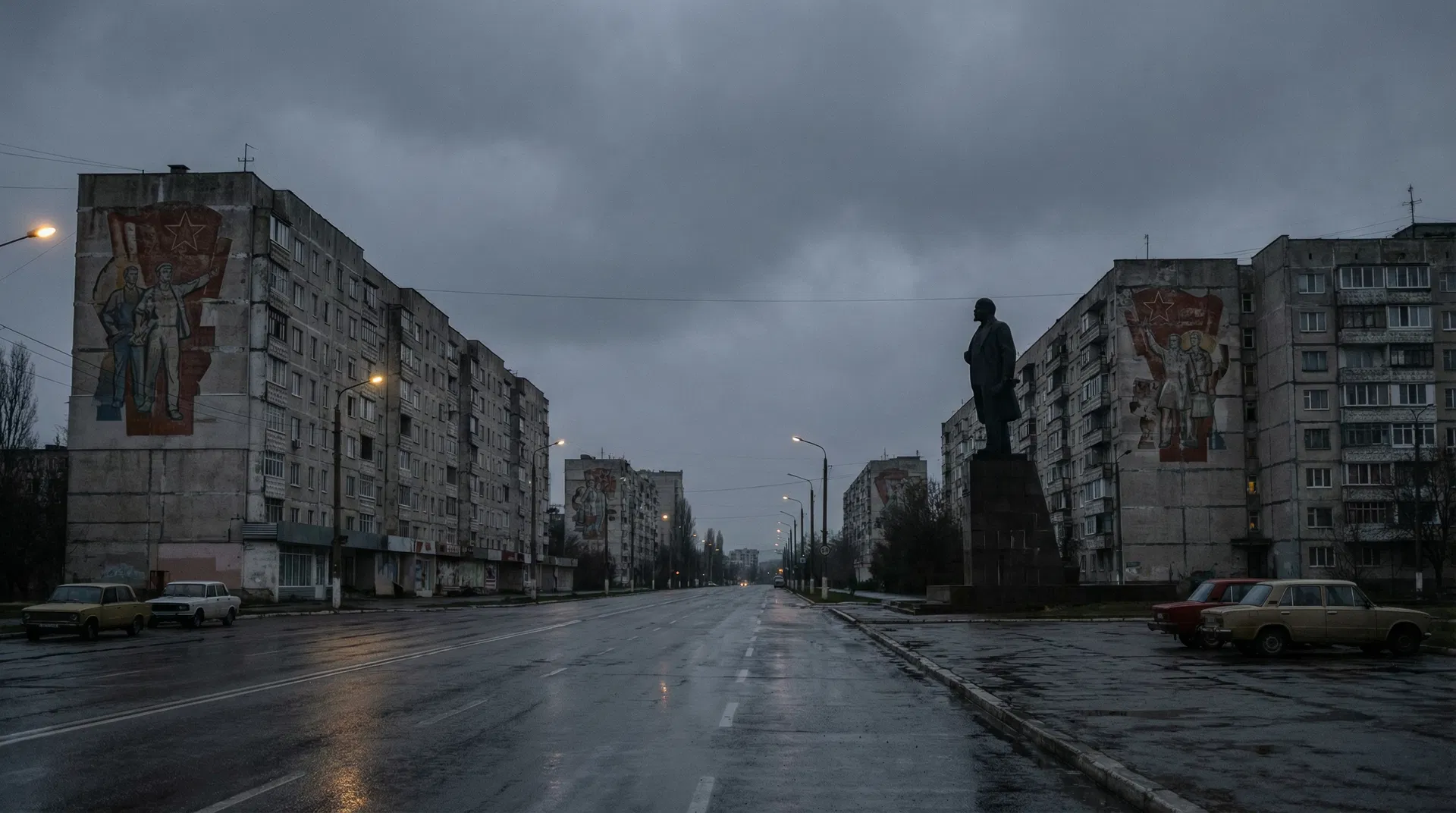
Transnistria
Tiraspol was founded in 1792 by Russian imperial General Suvorov as a military fortress, on the site of a Moldavian village of six houses. The Pridnestrovian Moldavian Republic (PMR) has been frozen since the 1992 war, entirely dependent on Russian energy subsidies. Moldova's 2022 EU accession candidacy creates a structural opportunity analogous to the conditions that enabled the South Tyrol resolution.
Key Fact
Transnistria is unrecognised by any UN member state — including Russia — yet functions as a de facto independent entity entirely dependent on Russian energy subsidies. The Russian 14th Army has been stationed there since 1992.
Historical Timeline
| Period | Ruling Authority | Notes |
|---|---|---|
| 1792 | Russian Empire | General Alexander Suvorov founds Tiraspol as a military fortress on the site of a Moldavian village of ~6 houses |
| 1924–1940 | Soviet Union (Moldavian ASSR, part of Ukraine) | Tiraspol becomes capital of Moldavian ASSR in 1929 |
| 1940 | Soviet Union (Moldavian SSR) | Bessarabia annexed via Molotov-Ribbentrop Pact; Tiraspol integrated into new Moldavian SSR |
| 1941–1944 | Romanian / Axis occupation | Romanian administration; Jewish population largely exterminated |
| 1944–1991 | Soviet Union (Moldavian SSR) | Soviet industrialisation brings large influx of Russian-speaking workers; city heavily Russified |
| 1990–1992 | Conflict and war | Transnistrian separatists backed by Russian 14th Army; 1992 war with Moldova; ceasefire |
| 1992–present | De facto: PMR / De jure: Moldova | Frozen conflict; Russian 14th Army present; PMR unrecognised internationally; dependent on Russian energy subsidies |
| 2022 | Moldova EU accession candidacy | Structural opportunity created: supranational framework emerging that could reduce existential stakes of sovereignty question |
| 2024 | Russian gas supply reduction | Economic isolation of PMR deepens; dependency on Russian subsidies increasingly untenable |
Foreign Policy Analysis
Three-level analysis: systemic, state, and individual factors
Systemic Level
Russia's strategic interest in maintaining the 14th Army and keeping the conflict frozen has been the primary obstacle to resolution. Moldova's EU accession candidacy (2022) and the reduction of Russian gas supplies (2024) have begun to shift this calculation. A durable resolution will require explicit diplomatic engagement with Russia's security concerns.
State Level
A viable strategy requires three elements: (1) A credible autonomy arrangement guaranteeing Russian as co-official language, protecting cultural institutions, and providing meaningful fiscal autonomy within a Moldovan constitutional framework. (2) EU accession structured to extend economic and civic benefits to Transnistrian residents willing to accept Moldovan citizenship. (3) Diplomatic engagement with Russia's security concerns at the systemic level.
Individual Level
Transnistria's population faces a choice between the economic isolation of the PMR status quo and the economic opportunity of EU membership via Moldovan citizenship. The reduction of Russian energy subsidies in 2024 has made the status quo increasingly costly. The EU accession trajectory offers a material incentive for resolution that did not previously exist.
Policy Paths
Three documented approaches to resolution — with their consequences
Status Quo Maintenance
Continue the current arrangement: PMR as a de facto independent entity, Russian 14th Army present, OSCE-mediated 5+2 talks ongoing but inconclusive.
Consequences
Increasingly untenable as Russian energy subsidies decline and Moldova's EU accession trajectory advances. The PMR economy is contracting; the population is ageing and emigrating. The status quo is not stable — it is slowly collapsing.
Examples
The 5+2 format (Moldova, PMR, Russia, Ukraine, OSCE, EU, US) has produced no substantive progress since the 2003 Kozak Memorandum was rejected.
Federalisation
A federal or confederal arrangement giving Transnistria substantial autonomy within a Moldovan constitutional framework, with Russian as a co-official language and guarantees for cultural institutions.
Consequences
The 2003 Kozak Memorandum proposed exactly this — and was rejected by Moldova under Western pressure. A revised federalisation proposal, structured around EU accession rather than Russian guarantees, could be viable if Russia's leverage continues to decline.
Examples
The Kozak Memorandum (2003) — rejected. Bosnia-Herzegovina's Dayton structure — a cautionary example of federalisation that froze rather than resolved the conflict.
EU Accession as Resolution Framework
Use Moldova's EU accession trajectory to create material incentives for Transnistrian residents to accept Moldovan citizenship and the EU framework, making the sovereignty question secondary to economic opportunity.
Consequences
The most promising current path. Requires Moldova to offer a credible autonomy arrangement and Russia to accept reduced leverage. The reduction of Russian gas subsidies in 2024 has weakened Russia's hand significantly.
Examples
South Tyrol: EU membership made the Italian-Austrian border irrelevant. Cyprus: EU accession was attempted as a resolution mechanism but failed because the political settlement was not agreed first.
Conditional Equilibrium
Transnistria's frozen status has been maintained by a single structural condition: Russian energy subsidies making the PMR's economic isolation tolerable. The reduction of those subsidies in 2024 has fundamentally altered the equilibrium. The PMR is now in a position where the status quo is more costly than it has ever been, while Moldova's EU accession trajectory offers an alternative that did not previously exist. Whether this produces resolution or a different form of instability depends on whether Moldova offers a credible autonomy arrangement and whether Russia accepts reduced leverage in exchange for diplomatic engagement.
Escalation Risk
Probability assessment and specific trigger conditions for conflict escalation
Transnistria's escalation risk has paradoxically decreased as Russia's leverage has weakened following the 2022 Ukraine war. The PMR is increasingly isolated and economically dependent. The primary risk is not armed conflict but a disorderly collapse of the PMR that Moldova is unprepared to manage.
Russian military corridor through Ukraine
low probabilityRussia's 2022 invasion of Ukraine was partly motivated by a desire to establish a land corridor to Transnistria. If Russia were to achieve this, it would dramatically increase its ability to project force into the PMR and potentially use Transnistria as a staging ground for further operations.
PMR economic collapse producing refugee crisis
medium probabilityIf the PMR economy collapses faster than Moldova can manage, a large-scale population movement into Moldova proper could destabilise Moldovan politics and create conditions for Russian intervention framed as humanitarian.
Moldova EU accession stalling
medium probabilityThe EU accession trajectory is the primary positive incentive for resolution. If Moldova's accession stalls — due to EU enlargement fatigue or Moldovan domestic politics — the window for a negotiated settlement may close.
Historical Analogue
East Germany 1989: an economically unviable entity whose population voted with their feet once the external patron's support was withdrawn. The parallel is imperfect but structurally suggestive.
Sources & Further Reading
Key academic works, primary documents, and institutional reports cited in this analysis. Sources are drawn from multiple national and institutional perspectives; where sources conflict, the divergence is noted.
The Moldovans: Romania, Russia, and the Politics of Culture
King, C. · 2000
Standard account of Moldovan identity politics; written from a broadly Western perspective
EU Foreign Policy and Post-Soviet Conflicts: Stealth Intervention
Popescu, N. · 2011
Analysis of EU policy toward frozen conflicts; includes detailed Transnistria chapter
'Transdniestria': What Is It, and What to Do About It?
Troebst, S. · 2003
Influential early analysis of the Transnistrian conflict; published in SAIS Review
Annual Reports on the Situation in Moldova and Transdniestria
OSCE Mission to Moldova · 2023
Primary institutional source; OSCE perspective on the conflict
Memorandum on the Basic Principles of the State Structure of a United State in Moldova (Kozak Memorandum)
Kozak, D. · 2003
Primary source: the Russian-drafted federalisation proposal rejected in 2003; reveals Russian strategic objectives
Unrecognized States: The Struggle for Sovereignty in the Modern International System
Caspersen, N. · 2012
Comparative study of unrecognised states; Transnistria as a central case