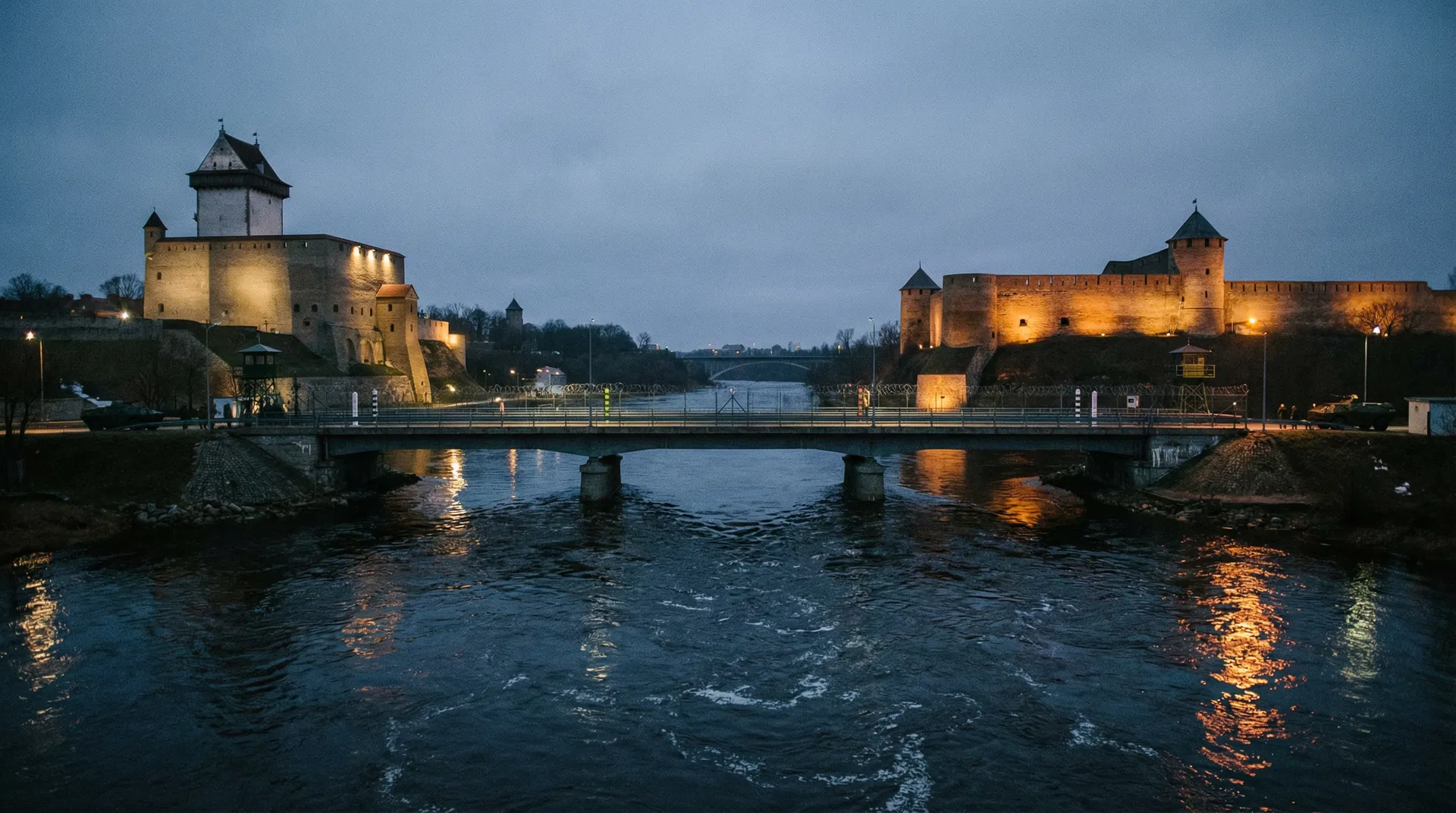
Narva
Narva is Estonia's most consequential foreign policy question that is not yet a crisis. With ~90% Russian-speaking population on NATO's eastern border, the city represents a decision point. The current population was not brought to an existing Estonian city — they were brought to a ruin destroyed by Soviet bombing in 1944 and built their lives there across multiple generations. Estonia faces three documented paths: assimilation, financial incentives, or the autonomy model.
Key Fact
Narva was 90% destroyed by Soviet bombing in 1944. The current ~97% Russian-speaking population was not brought to an existing Estonian city — they were brought to ruins and built their lives there across multiple generations.
Historical Timeline
| Period | Ruling Authority | Notes |
|---|---|---|
| Medieval | Danish, then Livonian Order | Germanic Hanseatic trading culture; fortress city |
| 1581–1704 | Swedish Empire | Major baroque development; city shaped by Swedish imperial architecture |
| 1704–1917 | Russian Empire | Baltic German nobility dominant |
| 1918–1940 | Republic of Estonia | Estonian national period; 1934 census: 65% ethnic Estonian |
| 1940–1944 | Soviet occupation, then WWII | Soviet annexation 1940; city 90% destroyed by Soviet bombing campaigns March–July 1944 |
| 1944–1991 | Soviet Union (Estonian SSR) | City rebuilt from ruins; repopulated with Soviet workers from Russia; by 1989: ~97% Russian-speaking |
| 1991–present | Republic of Estonia | Estonian sovereignty restored; Russian-speaking population holds Estonian or stateless status; integration contested |
Foreign Policy Analysis
Three-level analysis: systemic, state, and individual factors
Systemic Level
Estonia operates within a structural environment that both constrains and enables its choices. As a NATO and EU member, the existential stakes of the sovereignty question are lower than outside that framework. However, Russia retains a strategic interest in the ambiguity of Narva's status — a resolved, contented Russian-speaking population would remove a significant lever of pressure on NATO's eastern flank.
State Level
Three paths are available: (1) Cultural assimilation — Estonia's default since 1991, with documented risk of deepening grievance. (2) Financial incentive model — formally voluntary departure payments, but structurally analogous to asking third-generation residents to 'return' to a country they have no connection to; risks characterisation as ethnic cleansing by financial means. (3) Autonomy model — co-official language rights, cultural recognition, civic inclusion within the existing state framework.
Individual Level
Narva's population remains in civic limbo — legally Estonian or stateless, culturally Russian, economically marginal, politically invisible in Tallinn. Field observation and interviews with Russian-Estonians who have relocated to Tallinn reveal a consistent pattern: the primary grievance is not political allegiance to Russia but the absence of a framework in which Russian identity is compatible with full Estonian civic belonging.
Policy Paths
Three documented approaches to resolution — with their consequences
Cultural Assimilation
Continue prioritising Estonian language acquisition and civic integration without formal recognition of Russian as a co-official language or cultural autonomy for Narva.
Consequences
Progressive deepening of a grievance that lacks a legitimate institutional outlet. Historical pattern from Kosovo and Northern Ireland points toward escalation rather than organic integration when minorities are denied cultural recognition.
Examples
Estonia's default policy since 1991. Northern Ireland pre-Good Friday Agreement. Kosovo pre-1974 autonomy.
Financial Incentive Model
Offer voluntary departure payments to residents willing to renounce residency or citizenship and return to their country of origin. Currently practised by Denmark.
Consequences
Risks characterisation as ethnic cleansing by financial means. Many Narva residents have no meaningful connection to Russia — it is the country their grandparents were brought from under Soviet compulsion. Formal voluntariness does not insulate the scheme from this characterisation when the geopolitical context makes the offer read as coercion dressed as choice.
Examples
Danish voluntary departure scheme. Structurally analogous to offering a third-generation South Tyrolean money to 'return' to Germany.
Autonomy Model
Co-official language rights, cultural recognition, and meaningful civic inclusion within the existing state framework. Modelled on South Tyrol (1992) and Aceh, Indonesia (2005).
Consequences
Carries domestic political costs but, on the comparative evidence, offers the most durable route to removing the strategic ambiguity that currently serves Russia's interests more than Estonia's. Does not reward Soviet demographic engineering — responds to a humanitarian reality that predates any individual's choice.
Examples
South Tyrol (1992) — Italy's wealthiest province. Aceh, Indonesia (2005) — genuine autonomy ended a 30-year conflict. Åland Islands (Finland) — Swedish-speaking autonomous region, model of peaceful coexistence.
Escalation Risk
Probability assessment and specific trigger conditions for conflict escalation
Narva is the most strategically sensitive unresolved minority situation in NATO territory. Russia's demonstrated willingness to use Russian-speaking minorities as a pretext for intervention — as in Crimea (2014) and Donbas (2014–2022) — makes the structural conditions in Narva a genuine security concern, not merely a domestic integration question.
Russian military pressure on NATO's eastern flank
medium probabilityA Russian military operation against Estonia — framed as protection of Russian-speaking citizens — would use Narva's demographics as justification. This is the Crimea playbook: manufacture a humanitarian pretext, deploy forces, present a fait accompli. NATO's Article 5 commitment is the primary deterrent, but deterrence is not resolution.
Estonian escalation of language policy
medium probabilityEstonia has progressively restricted Russian-language education. A sharp escalation — such as eliminating Russian-language schooling entirely — could produce a civic crisis in Narva that provides Russia with a pretext for intervention.
NATO cohesion fracture
low probabilityIf NATO's Article 5 commitment were credibly questioned — through US withdrawal or political paralysis — the deterrent value that currently keeps Narva stable would erode rapidly. This is the scenario that makes Narva a high-stakes case regardless of Estonian domestic policy.
Economic marginalisation producing civic unrest
medium probabilityNarva is Estonia's most economically marginalised city. Prolonged economic exclusion of the Russian-speaking population, combined with the absence of civic inclusion, creates conditions for organised unrest that could be exploited externally.
Historical Analogue
Crimea 2014: a Russian-speaking majority region used as a pretext for military annexation, framed as protection of Russian citizens abroad. The structural conditions in Narva are analogous; the NATO membership is the critical difference.
Sources & Further Reading
Key academic works, primary documents, and institutional reports cited in this analysis. Sources are drawn from multiple national and institutional perspectives; where sources conflict, the divergence is noted.
As an Amazon Associate, frozenconflicts.org earns from qualifying purchases. Book links support the site at no extra cost to you.
Estonia: Independence and European Integration
Smith, D.J. · 2001
Standard account of Estonian independence and minority policy; written from a broadly pro-Estonian perspective
Find on AmazonUnderstanding Processes of Ethnic Control: Segmentation, Co-optation and Dependency in Post-Communist Estonia
Pettai, V., Hallik, K. · 2002
Critical analysis of Estonian minority policy; published in Nations and Nationalism
Russians in the Former Soviet Republics
Kolstø, P. · 1995
Comparative study of Russian-speaking minorities in post-Soviet states; includes Estonia
Find on AmazonRecommendations on the Education Rights of Persons Belonging to National Minorities in Estonia
OSCE High Commissioner on National Minorities · 2004
Primary institutional source; OSCE perspective on Estonian language policy
Nationalism Reframed: Nationhood and the National Question in the New Europe
Brubaker, R. · 1996
Theoretical framework for understanding nationalising states, national minorities, and external homelands — directly applicable to the Estonia-Narva-Russia triangle
Find on AmazonThe Challenge of the Russian Minority: Emerging Multicultural Democracy in Estonia
Lauristin, M., Heidmets, M. (eds.) · 2002
Estonian academic perspective on the Russian minority question
Find on Amazon