Nagorno-Karabakh
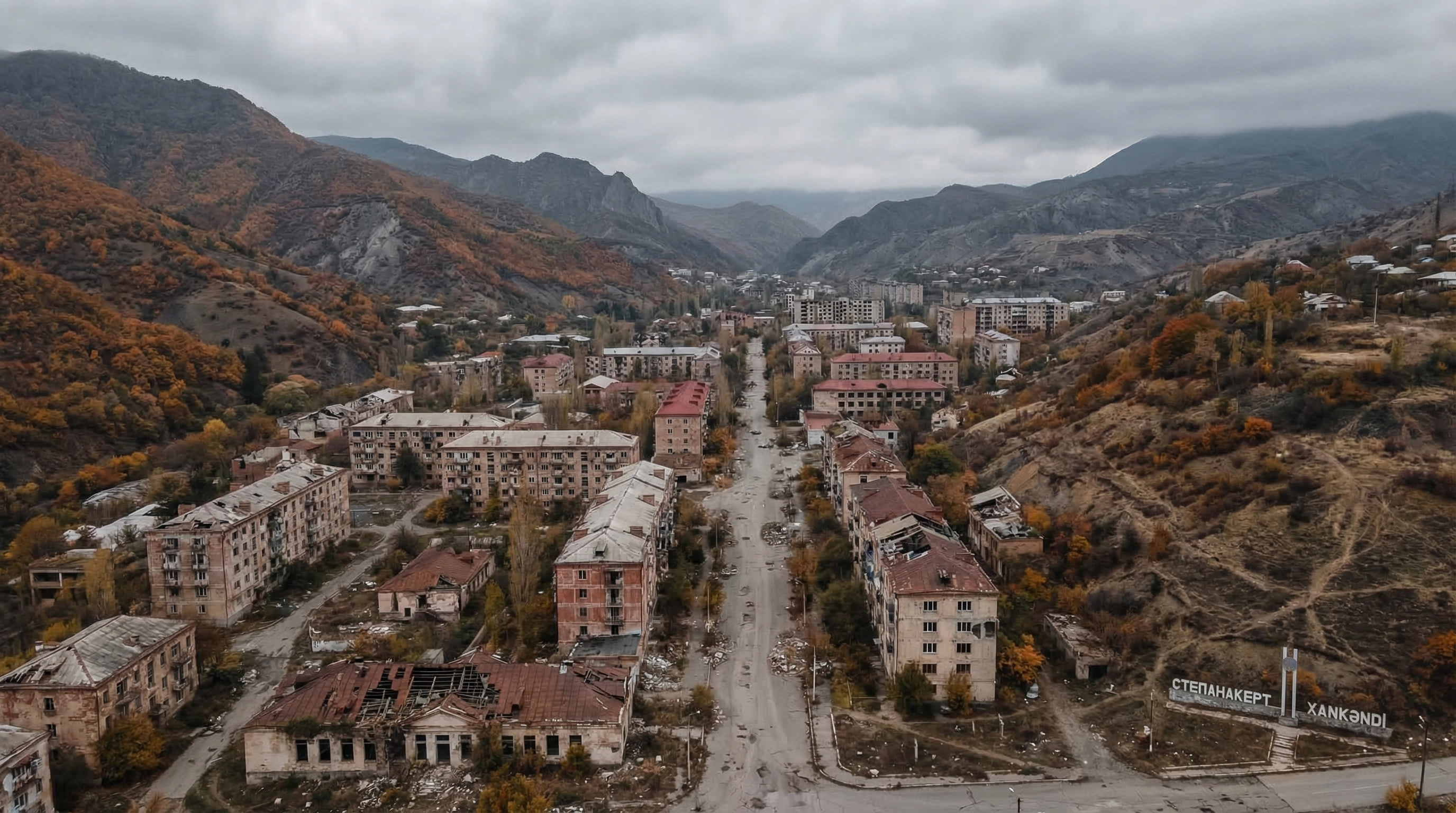
Nagorno-Karabakh was a frozen conflict from 1994 until Azerbaijan's 2020 and 2023 military offensives. The Republic of Artsakh dissolved in September 2023 following the 2023 Azerbaijani offensive, ending the conflict through violent thawing. Over 100,000 ethnic Armenians fled to Armenia within days. Nagorno-Karabakh is the most important recent case study in this database: it demonstrates that a frozen conflict can end through violent thawing even after 30 years of freeze, and that the international community's failure to implement a negotiated solution creates conditions for exactly this outcome.
Key Fact
The Republic of Artsakh dissolved on 1 January 2024 following Azerbaijan's September 2023 military offensive. Over 100,000 ethnic Armenians — virtually the entire population — fled to Armenia within days. This is the clearest recent example of a frozen conflict ending through violent thawing. The conflict also demonstrates the consequences of patron-state withdrawal: Russia's distraction by the Ukraine war removed the security guarantee that had maintained the freeze since 1994.
Historical Timeline
| Period | Ruling Authority | Notes |
|---|---|---|
| 1921 | Soviet assignment | Stalin assigns Nagorno-Karabakh (majority Armenian population) to Soviet Azerbaijan rather than Soviet Armenia; decision creates the territorial dispute that will define the conflict |
| 1988–1991 | Late Soviet period | Armenian population of Nagorno-Karabakh votes to join Soviet Armenia 1988; Azerbaijani pogroms against Armenians in Sumgait and Baku; violence escalates; Soviet Union collapses |
| 1991–1994 | First Karabakh War | Armenia and Azerbaijan gain independence; Nagorno-Karabakh declares independence; full-scale war; ~30,000 killed; Armenian forces capture Nagorno-Karabakh and seven surrounding Azerbaijani districts; ~600,000 Azerbaijanis displaced; ceasefire May 1994 |
| 1994–2020 | Frozen conflict | OSCE Minsk Group (France, Russia, US) mediates without result; periodic ceasefire violations; Azerbaijan rebuilds military with Turkish and Israeli weapons; Armenia relies on Russian security guarantees; Four-Day War 2016 (Azerbaijan captures some territory) |
| September–November 2020 | Second Karabakh War | Azerbaijan launches offensive September 27, 2020; Turkish-supplied Bayraktar drones decisive; Armenia loses ~5,000 soldiers; Azerbaijan recaptures most of surrounding districts; Russia brokers ceasefire November 10; Russian peacekeepers deployed |
| 2021–2023 | Lachin Corridor blockade | Azerbaijan blockades Lachin Corridor (the only road connecting Nagorno-Karabakh to Armenia) December 2022; humanitarian crisis; ICJ orders Azerbaijan to keep corridor open; Azerbaijan ignores order |
| September 2023 | Third offensive and dissolution | Azerbaijan launches 24-hour military offensive September 19, 2023; Republic of Artsakh surrenders; dissolution announced September 28; over 100,000 ethnic Armenians flee to Armenia within days; Republic of Artsakh formally dissolved January 1, 2024 |
Foreign Policy Analysis
Three-level analysis: systemic, state, and individual factors
Systemic Level
Nagorno-Karabakh's violent thawing in 2023 was the direct result of three systemic shifts: Russia's distraction by the Ukraine war (removing the security guarantee that had maintained the freeze); Turkey's active military support for Azerbaijan (providing Bayraktar drones and military advisors); and the OSCE Minsk Group's 30-year failure to produce a negotiated settlement. The conflict demonstrates the most important systemic lesson in this database: a frozen conflict without a patron-state guarantee is vulnerable to violent thawing when the balance of power shifts. Armenia's security guarantee was Russia; when Russia's attention and capacity were diverted to Ukraine, the guarantee became worthless.
State Level
Azerbaijan's position was consistent throughout: Nagorno-Karabakh is Azerbaijani territory, the Armenian occupation is illegal, and the ~600,000 Azerbaijani displaced persons have the right to return. Azerbaijan's military build-up over 30 years was explicitly aimed at recovering the territory by force if necessary. Armenia's position was that Nagorno-Karabakh's Armenian population had the right to self-determination and that Armenian security guarantees were necessary. The Republic of Artsakh's position was that it was an independent state. Note: Azerbaijani sources present the 2020 and 2023 offensives as the restoration of territorial integrity; Armenian sources present them as ethnic cleansing. The ICJ's order to keep the Lachin Corridor open, which Azerbaijan ignored, is the most authoritative primary source on the humanitarian dimension.
Individual Level
Ilham Aliyev's decision to launch the 2020 and 2023 offensives was calculated: he waited until Russia was sufficiently distracted by Ukraine, Turkey's military support was in place, and the Lachin Corridor blockade had weakened Artsakh's capacity to resist. The speed of the 2023 offensive (24 hours) and the subsequent mass exodus suggest that the outcome was planned in advance. Nikol Pashinyan's decision not to intervene militarily in 2023 was a recognition that Armenia could not win a war with Azerbaijan backed by Turkey.
Policy Paths
Three documented approaches to resolution — with their consequences
OSCE Minsk Group Negotiation (Failed)
The 30-year OSCE Minsk Group process aimed at a negotiated settlement based on the Madrid Principles (territorial integrity, self-determination, non-use of force).
Consequences
Failed to produce a settlement in 30 years. The three co-chairs (France, Russia, US) had competing interests that prevented agreement. Azerbaijan's military build-up made negotiation increasingly irrelevant. The Minsk Group process effectively ended with the 2020 war.
Examples
The Madrid Principles (2007): the framework for a negotiated settlement; never implemented. The Minsk Group is the clearest example in this database of international mediation failing to prevent violent thawing.
Violent Thawing (Occurred)
Azerbaijan's military offensives in 2020 and 2023 ended the frozen conflict through force.
Consequences
Azerbaijan recovered all of its internationally recognised territory. The Republic of Artsakh dissolved. Over 100,000 ethnic Armenians were displaced. The outcome was internationally accepted despite the ICJ's orders: no major state imposed sanctions on Azerbaijan. This outcome demonstrates that violent thawing can be internationally accepted if the aggressor has the right allies (Turkey, Israel) and the right timing (Russia distracted by Ukraine).
Examples
Croatia's Operation Storm (1995): military recovery of occupied territory; internationally accepted. The Nagorno-Karabakh case is the most recent example of violent thawing being accepted by the international community.
Armenian Return and Reconciliation
A long-term process in which ethnic Armenians who fled in 2023 are allowed to return to Nagorno-Karabakh under Azerbaijani sovereignty.
Consequences
Azerbaijan has stated that Armenians can return as Azerbaijani citizens. No significant return has occurred. The speed and totality of the 2023 exodus suggests that the Armenian population does not trust Azerbaijani guarantees. This path requires confidence-building measures that have not been taken.
Examples
Post-war reconciliation in the Western Balkans: slow and incomplete. The Dayton Agreement's provision for refugee return: largely unimplemented in Republika Srpska.
Armenia-Azerbaijan Peace Treaty
A formal peace treaty between Armenia and Azerbaijan, normalising relations and formally ending the conflict.
Consequences
Negotiations are ongoing as of 2025. Azerbaijan demands that Armenia amend its constitution (which references Nagorno-Karabakh) and renounce any future claims. Armenia is negotiating but faces domestic political opposition. A peace treaty would be the most positive outcome available at this stage.
Examples
Egypt-Israel Peace Treaty (1979): normalisation following the return of Sinai. Jordan-Israel Peace Treaty (1994).
Conditional Equilibrium
Nagorno-Karabakh is the most important case study in conditional equilibrium in this database. The 1994 ceasefire created a conditional equilibrium that was maintained for 30 years by three conditions: Russian security guarantees for Armenia, the OSCE Minsk Group process providing a diplomatic framework, and the military balance of power. All three conditions were eroded simultaneously: Russia's Ukraine war removed the security guarantee; the Minsk Group failed to produce a settlement; and Azerbaijan's military build-up (funded by oil revenues and supported by Turkey) shifted the balance of power decisively. When all three conditions eroded at the same time, the equilibrium collapsed. The lesson for other frozen conflicts is direct: a frozen conflict is only as stable as the conditions maintaining it.
Escalation Risk
Probability assessment and specific trigger conditions for conflict escalation
The Nagorno-Karabakh conflict has ended through violent thawing. The primary remaining risk is the failure to achieve a formal Armenia-Azerbaijan peace treaty, which could leave the conflict legally unresolved and create conditions for future grievances.
Failure of Armenia-Azerbaijan peace treaty negotiations
medium probabilityIf peace treaty negotiations fail, the conflict remains legally unresolved. Future Armenian governments could revive territorial claims, particularly if domestic political conditions change.
Azerbaijani military action against Armenia proper
low probabilityAzerbaijan has made territorial claims against parts of Armenia proper (Zangezur corridor). A military operation against Armenian territory would be a new conflict, not a continuation of the Nagorno-Karabakh conflict.
Historical Analogue
The post-1945 German expulsions: the displacement of ~12 million ethnic Germans from Eastern Europe was accepted by the international community as the price of post-war settlement. The Nagorno-Karabakh outcome has structural parallels.
Sources & Further Reading
Key academic works, primary documents, and institutional reports cited in this analysis. Sources are drawn from multiple national and institutional perspectives; where sources conflict, the divergence is noted.
Black Garden: Armenia and Azerbaijan Through Peace and War
de Waal, T. · 2003
The standard academic account of the Nagorno-Karabakh conflict; covers both Armenian and Azerbaijani perspectives
The Karabakh Trap: Dangers and Dilemmas of the Nagorny Karabakh Conflict
de Waal, T. · 2009
Analysis of the Minsk Group process and why it failed
International Court of Justice · 2021
ICJ proceedings on the Lachin Corridor blockade; the court ordered Azerbaijan to keep the corridor open; Azerbaijan did not comply
OSCE Minsk Group · 2007
The framework for a negotiated settlement; never implemented; the failure of the Minsk Group process is a central lesson of this conflict