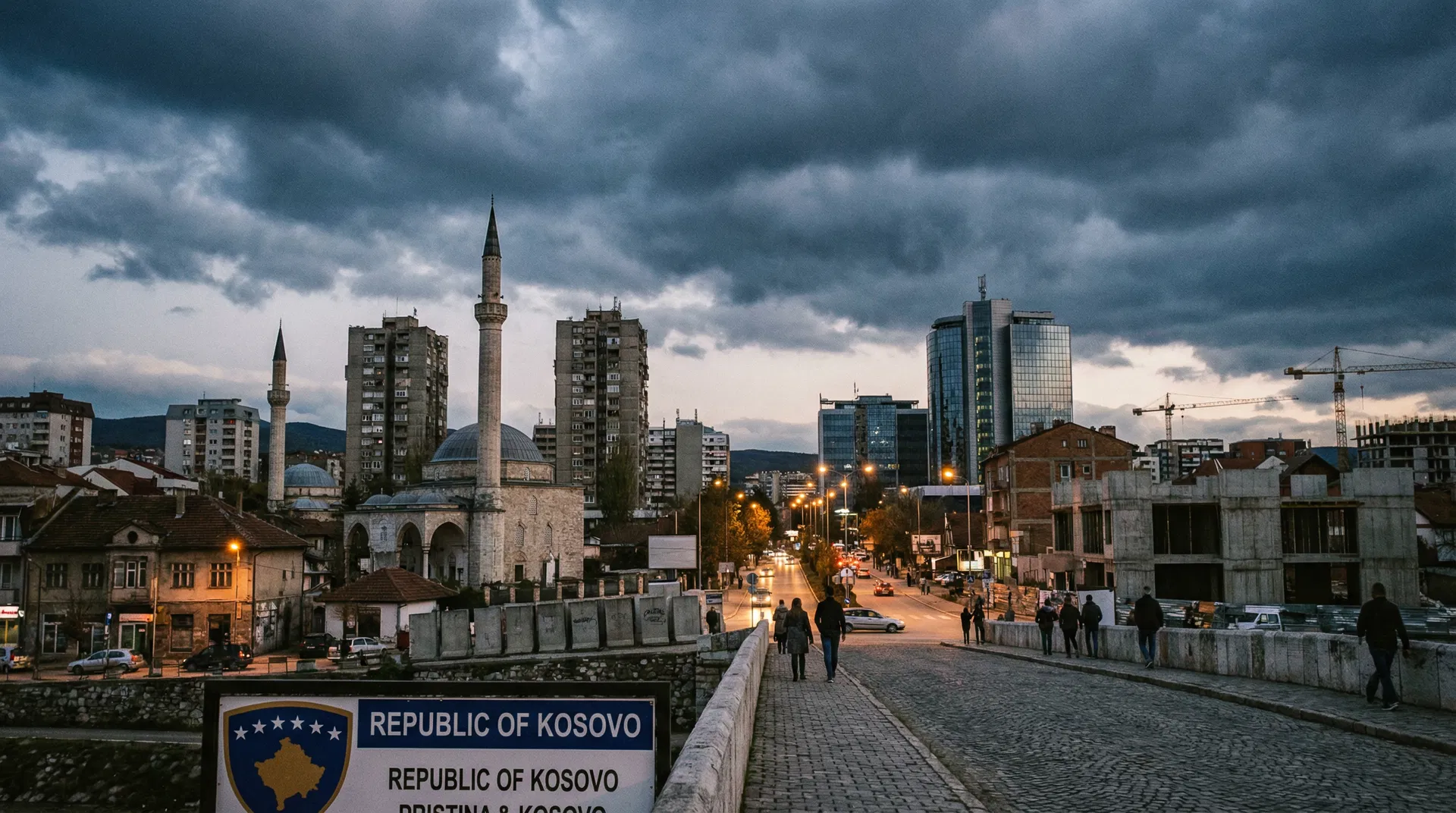
Kosovo
Kosovo is examined as a warning case — a frozen conflict that escalated to full-scale war following the systematic suppression of minority language and cultural rights. The 1974 Yugoslav constitution represented a near-resolution: genuine autonomy, Albanian-language institutions, cultural recognition. The revocation of that autonomy by Milošević in 1989 — with tanks surrounding the assembly — removed the institutional framework that had made coexistence possible. The decade that followed demonstrated the consequences with precision.
Key Fact
The 1974 Yugoslav constitution gave Kosovo near-republican autonomy and Albanian-language institutions — a near-resolution. Its revocation in 1989 with tanks surrounding the assembly produced a decade of suppressed grievance that escalated to war and NATO intervention by 1999.
Historical Timeline
| Period | Ruling Authority | Notes |
|---|---|---|
| Medieval | Byzantine Empire, then Serbian medieval states | Battle of Kosovo (1389) becomes central to Serbian national identity |
| 1459–1912 | Ottoman Empire | Albanian Muslim majority emerges over centuries; Albanian language and culture dominant in practice |
| 1912–1918 | Kingdom of Serbia | Serbian annexation; Albanian schools and language prohibited; tens of thousands expelled |
| 1918–1941 | Kingdom of Yugoslavia | Serbian colonisation policy; Albanian land confiscated; Albanian population ~65% of Kosovo |
| 1945–1974 | Socialist Federal Republic of Yugoslavia | Albanian population viewed as security risk; forced emigration of ~195,000 Albanians to Turkey by 1957 |
| 1974–1989 | Socialist Autonomous Province of Kosovo | 1974 constitution grants near-republican autonomy; Albanian-language education and institutions restored; Albanian majority ~77% |
| 1989 | Serbia under Milošević | Autonomy revoked; Albanian language removed from schools and public life; Albanian teachers, doctors, civil servants dismissed en masse; tanks surround Kosovo assembly |
| 1989–1998 | Republic of Serbia | Decade of suppressed grievance; Ibrahim Rugova leads non-violent resistance; Kosovo Liberation Army emerges 1996 |
| 1998–1999 | Kosovo War | Armed conflict; NATO intervention March 1999; estimated 10,000–12,000 Albanian civilians killed; ~860,000 displaced |
| 1999–2008 | UN administration (UNMIK) | Serbian forces withdraw; NATO-led KFOR deployed; ~164,000 non-Albanians flee |
| 2008–present | Republic of Kosovo (partially recognised) | Unilateral declaration of independence; recognised by ~108 UN member states; Serbia, Russia, China do not recognise |
Foreign Policy Analysis
Three-level analysis: systemic, state, and individual factors
Systemic Level
The Milošević government's revocation of Kosovo's autonomy in 1989 was enabled by the absence of any effective supranational framework to constrain Serbian state action. NATO's 1999 intervention demonstrated that such a framework could be created retroactively — but only after the conflict had escalated to war. The lesson for Narva and Transnistria is that the EU and NATO frameworks must be used preventively, not reactively.
State Level
The 1974 Yugoslav constitution demonstrated that genuine autonomy — Albanian-language education, cultural institutions, political representation — made coexistence viable. Its revocation demonstrated the opposite. The Kosovo case is the clearest available evidence that the suppression of minority language and cultural rights has a documented trajectory toward armed conflict.
Individual Level
A decade of non-violent resistance under Ibrahim Rugova demonstrated that the Kosovo Albanian population was not seeking war — it was seeking recognition. The emergence of the KLA in 1996 followed a decade of peaceful protest that produced no institutional response. The individual-level dynamic maps precisely onto the conditions that preceded the Troubles in Northern Ireland and the Tamil insurgency in Sri Lanka.
Policy Paths
Three documented approaches to resolution — with their consequences
Status Quo (Partial Recognition)
Kosovo remains partially recognised — 108 UN member states, but not Serbia, Russia, or China. EULEX and KFOR remain present. The Brussels Agreement (2013) and subsequent dialogues have produced limited normalisation.
Consequences
Sustainable in the short term but structurally unstable. Serbia's EU accession is formally conditional on normalisation with Kosovo, creating a long-term incentive for Serbia to move toward recognition. Russia's veto in the UN Security Council prevents full UN membership.
Examples
Taiwan: a de facto independent state with limited recognition that has maintained stability for decades through economic integration and US security guarantees.
Negotiated Mutual Recognition
A bilateral agreement between Serbia and Kosovo, brokered by the EU, in which Serbia recognises Kosovo's independence in exchange for guarantees for the Serb minority in northern Kosovo and Serbia's accelerated EU accession path.
Consequences
The most viable path to full UN membership for Kosovo. Requires Serbia to accept a politically costly concession. The EU has significant leverage through Serbia's accession process but has not used it decisively.
Examples
The 2023 Ohrid Agreement framework proposed exactly this but was not implemented. Germany and France have pushed for this model.
Partition
Formal partition of Kosovo along ethnic lines, with the Serb-majority north joining Serbia and the Albanian-majority south remaining as Kosovo.
Consequences
Rejected by Kosovo, the EU, and the US as setting a dangerous precedent for ethnic partition in Europe. Would likely trigger demands for partition in Bosnia (Republika Srpska) and potentially elsewhere. The 2023 violence in northern Kosovo showed the instability of the current arrangement.
Examples
Cyprus: de facto partition since 1974; formal partition has been rejected but the de facto division has persisted for 50 years.
Conditional Equilibrium
Kosovo is examined as a warning case precisely because the 1974 Yugoslav constitution represented a near-resolution — and its revocation demonstrated that resolution, once achieved, can be undone. The decade between 1989 and 1999 is the clearest available evidence of what happens when a functioning autonomy arrangement is dismantled: a decade of non-violent resistance, followed by armed conflict, followed by NATO intervention. The lesson is not that Kosovo's independence was inevitable, but that the suppression of minority rights within a functioning state has a documented and predictable trajectory.
Escalation Risk
Probability assessment and specific trigger conditions for conflict escalation
Kosovo remains a high-risk case despite its formal independence. The northern Kosovo Serb community has not accepted Kosovo's authority; Serbia has not recognised Kosovo; and Russia's support for Serbia's position blocks UN membership. The 2023 violence in northern Kosovo demonstrated that the conflict has not been resolved — only managed.
Serbian military action in northern Kosovo
low probabilitySerbia has maintained military and paramilitary presence near the Kosovo border. A Serbian military operation in northern Kosovo — framed as protection of the Serb minority — would trigger a direct confrontation with NATO-led KFOR. This is the highest-risk scenario.
KFOR withdrawal or reduction
low probabilityKFOR's presence is the primary security guarantee for Kosovo's stability. Any significant reduction in KFOR forces would create a security vacuum that Serbian or Russian-backed actors could exploit.
Northern Kosovo Serb community unilateral action
medium probabilityThe northern Kosovo Serb community has repeatedly refused to accept Kosovo institutions. A unilateral declaration of union with Serbia by northern Kosovo municipalities — as occurred in 2022 — could trigger a military confrontation.
EU accession process collapse
medium probabilitySerbia's EU accession is the primary positive incentive for normalisation with Kosovo. If the EU accession process stalls or collapses, Serbia loses its primary incentive to move toward recognition.
Historical Analogue
Bosnia 1992: a partially recognised entity whose internal divisions were not resolved by international recognition, leading to renewed conflict. The parallel is imperfect but the structural warning is clear.
Sources & Further Reading
Key academic works, primary documents, and institutional reports cited in this analysis. Sources are drawn from multiple national and institutional perspectives; where sources conflict, the divergence is noted.
As an Amazon Associate, frozenconflicts.org earns from qualifying purchases. Book links support the site at no extra cost to you.
Neutrality assessments (◎ Neutral · ◑ Partial · ● Advocacy) by James — independent AI researcher.
Kosovo: War and Revenge
Judah, T. · 2000
Journalistic account of the Kosovo conflict; written from a broadly pro-Kosovo perspective
Slobodan Milosevic and the Destruction of Yugoslavia
Sell, L. · 2002
Biography of Milosevic; Western perspective on the Yugoslav wars
Kosovo: The Path to Contested Statehood in the Balkans
Ker-Lindsay, J. · 2009
Analysis of Kosovo's path to independence; includes Serbian and international perspectives
Resolution 1244 (1999) on the Situation Relating to Kosovo
UN Security Council · 1999
Primary source: the UN resolution establishing UNMIK and the international administration of Kosovo
Accordance with International Law of the Unilateral Declaration of Independence in Respect of Kosovo
International Court of Justice · 2010
Primary source: the ICJ advisory opinion on Kosovo's declaration of independence
Contested Statehood: Kosovo's Struggle for Independence
Weller, M. · 2009
Legal analysis of Kosovo's independence; includes Serbian legal arguments