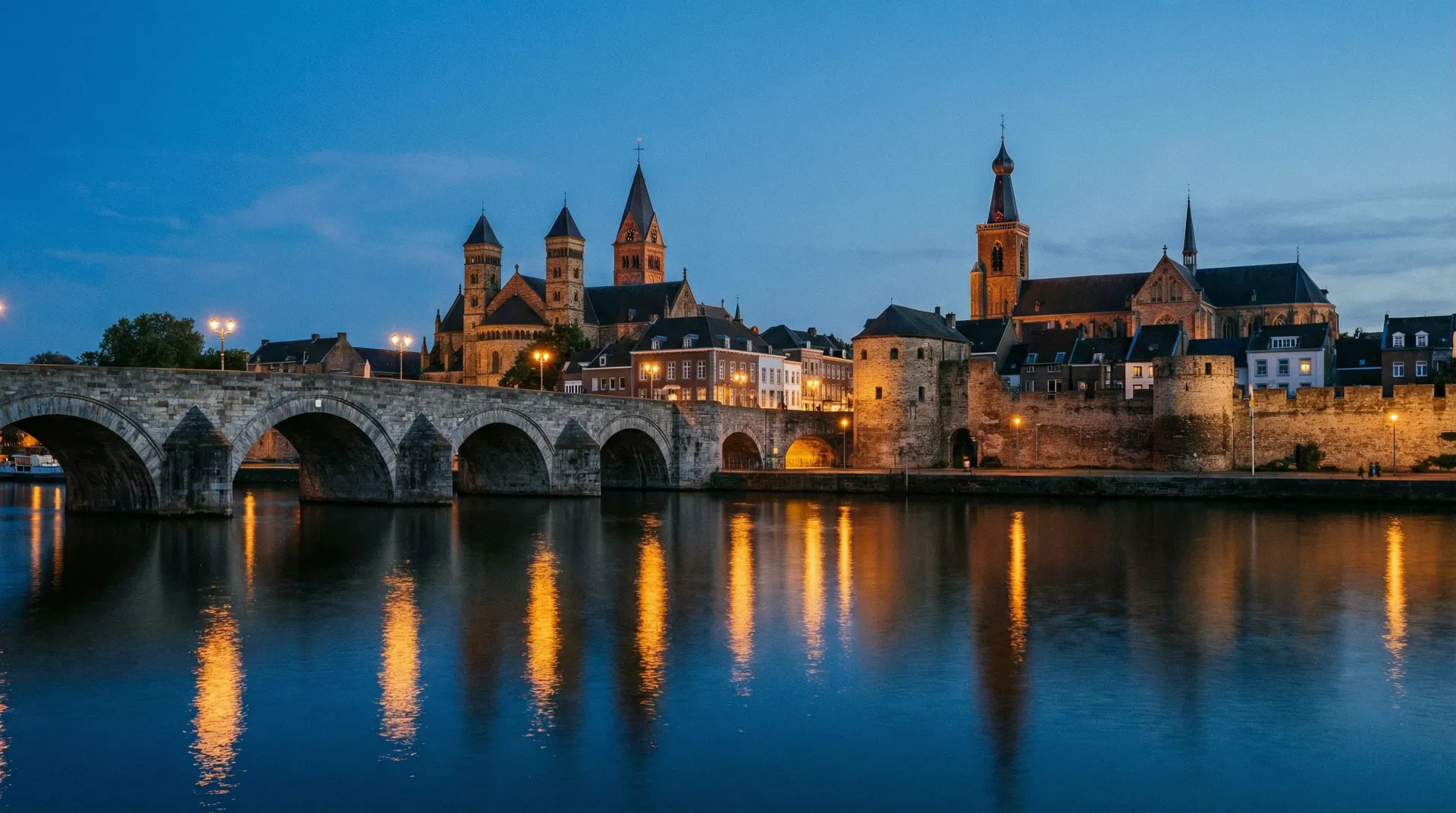
Maastricht / Limburg
Maastricht was itself a frozen conflict for eight years (1830–1839), held by a Dutch garrison while the surrounding countryside aligned with the Belgian revolution. The 1839 Treaty of London partitioned Limburg between two states, dividing a coherent cultural and linguistic region. In 1992, Maastricht became the birthplace of the European Union — the supranational framework designed to make such conflicts structurally less likely. Yet even here, linguistic and cultural grievances that were never fully addressed continue to resurface.
Key Fact
The city that was itself a frozen conflict for 8 years became in 1992 the birthplace of the EU — yet Limburgish autonomy sentiment continues to resurface, driven by linguistic and cultural grievances never fully addressed in the 1839 settlement.
Historical Timeline
| Period | Ruling Authority | Notes |
|---|---|---|
| Roman | Roman Empire | Trajectum ad Mosam — strategic crossing of the Meuse; major Roman road junction |
| Medieval | Prince-Bishopric of Liège / Duchy of Brabant | Unique dual sovereignty: city governed jointly by two lords simultaneously for ~600 years |
| 1204–1794 | Dual sovereignty (Liège + Brabant) | Maastricht is the only city in European history governed under formal dual sovereignty for six centuries |
| 1794–1814 | French Republic / Napoleonic Empire | Annexed by France; becomes part of the Département de la Meuse-Inférieure |
| 1815 | Kingdom of the Netherlands | Congress of Vienna assigns Maastricht and Limburg to the new United Kingdom of the Netherlands |
| 1830 | Belgian Revolution | Belgium declares independence; Limburg and Luxembourg contested |
| 1830–1839 | Frozen conflict period | Maastricht held by Dutch garrison while surrounding countryside aligns with Belgium; city effectively besieged; eight-year political deadlock |
| 1839 | Treaty of London | Limburg partitioned: western part becomes Belgian province; eastern part remains Dutch; Maastricht assigned to the Netherlands |
| 1867 | Luxembourg Crisis resolved | Limburg's status as part of the German Confederation formally dissolved; fully integrated into Dutch constitutional framework |
| 1992 | Treaty of Maastricht | The city that was itself a frozen conflict becomes the birthplace of the European Union |
| 1997–present | Recurring autonomy sentiment | Limburgish language recognised under European Charter for Regional or Minority Languages; regional parties consistently outperform national parties; autonomy sentiment persists |
Foreign Policy Analysis
Three-level analysis: systemic, state, and individual factors
Systemic Level
The 1839 resolution was imposed by the great powers — Britain, France, Austria, Prussia, Russia — through the Treaty of London, not negotiated between the parties. The partition of Limburg was a great-power convenience, not a reflection of cultural realities. The resolution held not because it was just, but because the great powers enforced it and neither state could challenge it.
State Level
The Netherlands never fully addressed the linguistic and cultural distinctiveness of Limburg. Limburgish — recognised under the European Charter for Regional or Minority Languages — received no official status in the Netherlands. Cultural institutions and regional identity remained distinct from the Dutch mainstream, creating persistent difference that has never been fully resolved.
Individual Level
The consequence is a recurring pattern of autonomy sentiment throughout the twentieth and twenty-first centuries. Surveys show consistent preferences for greater autonomy. Regional parties consistently outperform national parties in parts of Limburg. Primary identification remains regional rather than national for many Limburgers — a pattern that maps precisely onto the individual-level dynamics observed in South Tyrol, Narva, and Transnistria.
Conditional Equilibrium
Maastricht is the most paradoxical case in the European record. The city that was itself a frozen conflict became the birthplace of the EU — the supranational framework designed to make such conflicts structurally less likely. Yet even here, linguistic and cultural grievances that were never fully addressed continue to resurface. The city that gave the EU its name has not itself fully resolved the tensions that the EU was designed to manage. This is the central insight of conditional equilibrium: resolution is not a destination but a condition that must be actively maintained.
Escalation Risk
Probability assessment and specific trigger conditions for conflict escalation
Limburg's autonomy sentiment is a cultural and political phenomenon, not a security threat. The risk of armed conflict is negligible. The analytical value of this case is theoretical: it demonstrates that even a resolved conflict within a stable EU member state retains residual tensions.
EU institutional collapse
low probabilityThe EU framework is the primary structural reason Limburgish autonomy sentiment has not escalated. If the EU were to fragment significantly, the supranational framework that makes the Dutch-Belgian border irrelevant would erode, potentially giving renewed salience to the unresolved 1839 partition.
Dutch centralisation removing Limburgish language recognition
low probabilityLimburgish is recognised under the European Charter for Regional or Minority Languages. Withdrawal of that recognition, or a Dutch government policy of active assimilation, could intensify regional grievance.
Historical Analogue
Scotland within the UK: a resolved constitutional question that periodically resurfaces when the political context changes, without threatening armed conflict.
Sources & Further Reading
Key academic works, primary documents, and institutional reports cited in this analysis. Sources are drawn from multiple national and institutional perspectives; where sources conflict, the divergence is noted.
As an Amazon Associate, frozenconflicts.org earns from qualifying purchases. Book links support the site at no extra cost to you.
The Low Countries 1780–1940
Kossman, E.H. · 1978
Standard historical account of the Belgian revolution and the 1839 settlement; written from a Dutch-Belgian perspective
Find on AmazonPolitical History of Belgium from 1830 Onwards
Witte, E., Craeybeckx, J., Meynen, A. · 2009
Belgian perspective on the 1830 revolution and the partition of Limburg
Find on AmazonTreaty between the Five Powers, Austria, France, Great Britain, Prussia, and Russia, and Belgium
Treaty of London (1839) · 1839
Primary source: the treaty that partitioned Limburg and formally resolved the Belgian revolution
European Charter for Regional or Minority Languages
Council of Europe · 1992
Primary source: the charter under which Limburgish is recognised
De stad en de staat: Politieke cultuur en lokale politiek in Nederland
Mamadouh, V. · 1992
Dutch-language study of local political culture; includes analysis of Limburgish regional identity
Find on Amazon